How Much Do Deck Stairs Cost? A Practical Guide for Homeowners
- Simcoe Decks

- Mar 20
- 7 min read
Updated: Mar 22

Stairs are one of the most-used parts of any deck. They connect the deck to your yard, your garden, your hot tub zone, or the path to your garage. When it comes to budgeting a deck build or upgrade, stairs are also one of the areas where homeowners are most often caught off guard. The cost to add stairs to a deck can vary significantly based on factors that aren't always obvious up front.
This guide is designed to change that. Whether you're planning a new custom composite deck or looking to upgrade the stairs on an existing one, here's a clear breakdown of what drives deck stair costs in Ontario - and how to plan realistically before a single board is cut.
Why Deck Stairs Cost More Than People Expect
Deck stairs aren't just boards nailed together. The number one reason stairs cost more than most homeowners expect is that they're genuinely more intricate and time-consuming to build than the deck itself. Each individual rise and run essentially becomes its own mini deck - with the same level of finishing detail, precision, and craftsmanship applied repeatedly across every step.
That complexity adds up quickly. A properly built staircase involves precise structural engineering, material selection, railing integration, footings, and often permits. The finishing details alone - the way each tread is cut, fitted, and fastened - require the kind of care that can't be rushed without compromising the result. Each element matters for safety, longevity, and code compliance.
In Ontario, deck stairs attached to a home or exceeding certain heights typically fall under Ontario's Building Code. That means rise-and-run ratios, handrail heights, and load-bearing requirements all have to be met - and that takes skilled labour and the right materials to execute properly.
The good news: understanding what goes into a stair build gives you a much clearer picture of why quotes look the way they do, and helps you ask better questions when comparing builders.

Key Factors That Affect Deck Stairs Cost
1. Number of Steps and Overall Height
The most direct cost driver is simply how far the deck is from the ground. A low deck with three or four steps is a very different project than a second-storey deck requiring twelve or more. More steps mean more stringers, more risers and treads, more railing posts, and more time on site.
The height of the deck also affects footing requirements at the base of the stairs. Taller stairs typically need a concrete pad or footing at the bottom to provide a stable, frost-resistant landing point - especially important in Ontario's climate where unpredictable weather cycles can shift the ground significantly each year.
2. Stair Width
Standard stairs often start around 48" wide, but depending on customer preference and design details, going wider sometimes makes more sense for the space - it just adds to the overall cost. Wider stairs have a more open, welcoming look and can feel like a natural extension of a larger deck, but they require additional stringers and more material overall. Grand or feature-style staircases with full-width landings are beautiful and make a strong design statement, though they do add meaningful cost. If you've seen sweeping deck staircases in completed projects by our team, those wider designs reflect both more material and more labour time.
3. Deck Stair Materials
Material choice has one of the biggest impacts on overall deck stairs cost. Here's how the main options compare:
• Composite deck stairs - The surface material of choice for every staircase Simcoe Decks builds. Composite treads and risers match the rest of the deck surface, require no staining or sealing, and hold up exceptionally well through Ontario winters. The result is a staircase that looks as good in year ten as it did on day one.
• Structural framing - While the visible surface is always composite, the structural components beneath matter just as much. Pressure-treated lumber is standard for stair stringers, while steel framing - used throughout our builds for longevity reasons - provides superior resistance to rot, movement, and long-term wear. Steel framing on taller staircases adds upfront cost but significantly improves structural integrity over time.
• Steel framing upgrade - For taller or wider staircases, full steel stringer systems offer the highest level of long-term performance. This is part of the same steel framing approach used across all Simcoe Decks projects.
4. Landing Platforms
Deck stairs with a landing - a flat platform mid-stair, at the bottom, or at a change in direction - add both cost and functionality. Landings are often required by code when a staircase changes direction, and they're also a practical comfort feature on taller decks. A landing is essentially a small deck in itself: it needs its own framing, decking surface, and potentially its own footing.
It’s worth thinking beyond just the upper landing, too. On larger staircases, homeowners will often ask for a landing closer to the bottom to help break up a long run of stairs - and it's a great design move. Doing so can greatly affect the overall cost. A lower landing brings its own set of considerations: helical footings, landing framing, decking, and railing all have to be accounted for, and those details add up in both materials and labour.
If your outdoor space includes a lower level, a hot tub area, or a change in direction, planning for all landings from the start - wherever they fall on the staircase - is far more cost-effective than retrofitting them later.
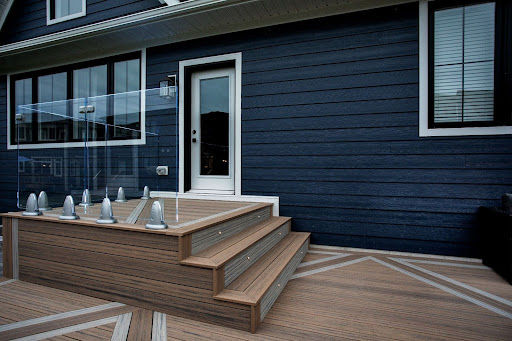
5. Deck Stair Railing Cost
Railing is a required component on most staircases meeting Ontario Building Code height thresholds - and it's also one of the most visible design elements of the staircase. Railing choices range significantly in cost:
• Aluminum balusters - Clean, low-maintenance, and weather-resistant. A popular choice that pairs well with composite decking.
• Glass panel railing - A premium option that maximizes sightlines and creates a modern, open look. Higher material and installation cost, but highly sought after in properties with views or contemporary architecture.
• Cable railing - A sleek alternative to glass with a slightly lower price point. Requires proper tensioning and periodic inspection.
The railing style you choose for your stairs should match the rest of your deck's railing system for a cohesive finished look. Mixing styles mid-project is one of the most common sources of budget surprises.
6. Permits and Site Conditions
In Barrie, Collingwood, the Blue Mountains, and across Simcoe and Grey County, permits are commonly required for deck stairs depending on the height of the deck and whether the structure is attached to the home. Your builder should factor permit costs and any required inspections into the project plan from the beginning.
Site conditions also matter. Sloped lots, rocky ground, limited access for equipment, or soft soil can all affect how footings are installed at the base of the stairs - adding both time and material cost to the project.
What Does It Cost to Add Stairs to a Deck in Ontario?
Deck stairs cost in Ontario varies widely based on everything covered above. A straightforward composite staircase on a low deck is a very different investment than a wider staircase with a landing, glass railing, and integrated lighting on a taller deck. The materials, height, and design complexity all move the number meaningfully.
Rather than quoting ranges that can be misleading without context, the most honest answer is this: the cost to add stairs to a deck is directly proportional to the complexity, materials, and height involved. A builder who understands your specific project can give you a far more accurate number than any general estimate.
At Simcoe Decks, every project starts with a site-specific conversation rather than a number pulled from a spreadsheet. That approach leads to fewer surprises and a finished result that actually reflects what the homeowner envisioned. You can start that conversation here.

Integrated Lighting: A Smart Add-On for Stairs
Deck stairs with integrated lighting are one of the most practical upgrades a homeowner can make. Step lighting improves nighttime visibility, reduces trip hazards, and adds a finished, intentional look to the staircase after dark. When lighting is planned at the design stage, it can be wired cleanly through the risers or stringers without surface-mounted conduit cluttering the look.
Our integrated lighting service covers stair riser lighting, post-cap lights, and deck surface lighting - all designed to work as part of a cohesive system rather than as an afterthought. If you're investing in quality stairs, lighting is an addition that pays for itself in daily usability.
Planning Deck Stairs as Part of a Broader Build
The most cost-effective time to plan and build deck stairs is as part of a complete deck project. When stairs are designed alongside the deck, material orders are consolidated, labour is already on site, and structural decisions - like footing placement and framing direction - can be made together.
Adding stairs to an existing deck after the fact is absolutely possible, but it typically involves additional site visits, potentially opening up existing framing, and re-ordering materials. For homeowners planning a new build or a full deck replacement, this is the moment to get the stair design right.
If you're in the early stages of planning, the Simcoe Decks Buyer's Guide is a useful starting point. It covers how materials, structure, and accessories fit together before any build decisions are locked in.
Extending Your Deck's Usability Beyond the Stairs
Well-designed stairs are the gateway to a deck that gets used every day - but the full outdoor living experience doesn't stop there. Homeowners who invest in quality stairs often find themselves wanting to make the rest of the deck match that same level of thought and finish.
Features like pergolas, as well as motorized screens, and outdoor heaters all contribute to a deck that stays in use beyond the peak summer months. In Ontario's climate, that extended usability is often the difference between a deck that's enjoyed a few months a year and one that becomes a genuine part of daily life.
Final Thoughts: Budget for What the Space Actually Needs
Deck stairs cost is a topic that rewards early planning. The more clearly you understand what drives pricing - height, materials, width, landings, railing, and permits - the better equipped you are to have a productive conversation with your builder and make decisions that hold up over time.
For homeowners in Barrie, Collingwood, the Blue Mountains, and across Simcoe and Grey County, working with a local builder who understands Ontario's climate, building requirements, and material performance makes a real difference in outcomes. Reach out to Simcoe Decks to talk through your project - no pressure, just a practical conversation about what your space needs and what it will take to build it right.


After finishing work in canada I wanted something relaxing to pass the evening, so I opened a gaming thread where several people were discussing surprising comeback wins. One user mentioned Caxino Casino, and curiosity pushed me to try it. The first thing I noticed was that the games ran smoothly without freezing or long waits. My own session got off to a terrible start though, and I spent the first part losing almost every round. I seriously thought about stopping before things got worse, but then a bonus feature suddenly activated and flipped the entire session around. Somehow I recovered everything and still ended ahead, which honestly changed my mood completely.
Hey everyone, I’m from Canada and came across this while browsing a local forum where people were talking about how they spend their evenings online. I got curious and ended up exploring lethbridge casino. What caught my eye was how quickly everything loads and how simple the navigation feels. I tried a few games just to test it out, had a slow start and almost stopped, but later managed to get a small recovery that kept me going. It felt relaxed, like something you can open casually without any pressure.